Funding capacity • October 2026
What the budget can fund
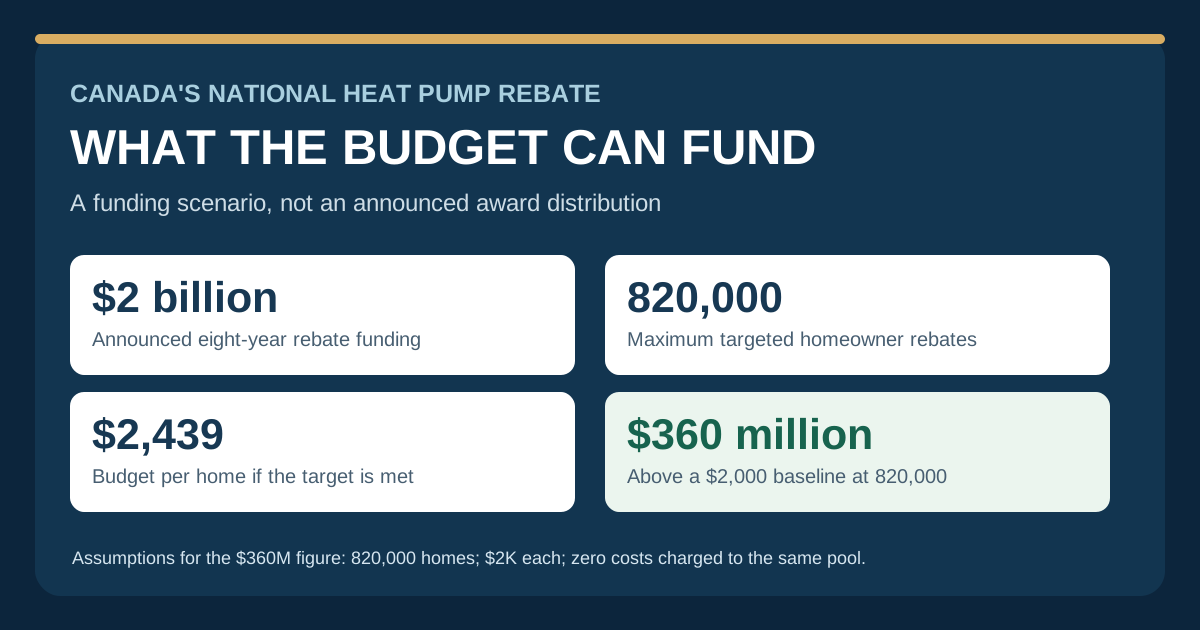
If the programme reaches 820,000 households, allocating $2,000 to each would use $1.64 billion of the announced $2 billion envelope. That leaves $360 million for payments above $2,000, before any administration charged to the same envelope. The number of households that can receive larger payments depends on their average rebate—not simply the advertised $10,000 maximum. The announcement does not disclose the expected payment distribution.
The national programme, announced October 8, 2026, offers a standard $2,000 payment to eligible households and up to $10,000 for eligible households below the median income. At the upper-end participation target of 820,000, the envelope represents approximately $2,439 per home. That is a budget-per-target ratio, not an average award promised by Ottawa. Source: Environment and Climate Change Canada, October 8, 2026.
What is announced, and what is still unknown?
| Item | What official materials say | What remains unresolved |
|---|---|---|
| Homeowner programme envelope | $2 billion over eight years; up to 820,000 homeowners. | Actual take-up, annual allocation and spending profile. |
| Standard award | $2,000 for other eligible homeowners. | How many applicants ultimately receive this amount. |
| Higher award | Up to $10,000 for eligible below-median-income households. | Average award within that tier and the eventual income assessment rules. |
| Equipment | Eligible electric cold-climate air-source heat pumps on an Eligible Products List. | Final purchase-specific conditions and rollout details. |
| Administration | The October 8 backgrounder specifies the envelope but no programme administration deduction. | Whether and how much administration or delivery expenditure is paid from that same $2B. |
Evidence category: official announcement. These are amounts and descriptions in the October 8 ECCC backgrounder and Prime Minister’s release. They are not observed programme outcomes.
Exhibit A: Announced programme components
The government separately described three distinct mechanisms: up to 820,000 homeowner rebate awards, up to 250,000 rental units supported through CMHC’s Multi-Unit Mortgage Loan Insurance, and up to 30,000 residential units supported through the Canada Infrastructure Bank’s Building Retrofits Initiative. The CMHC programme is described as leveraging private capital through existing mortgage insurance, rather than relying on new direct federal spending; the CIB initiative uses its existing government allocation. These are not equivalent cash payments. Source: federal backgrounder, October 8, 2026, sections on CMHC and CIB.
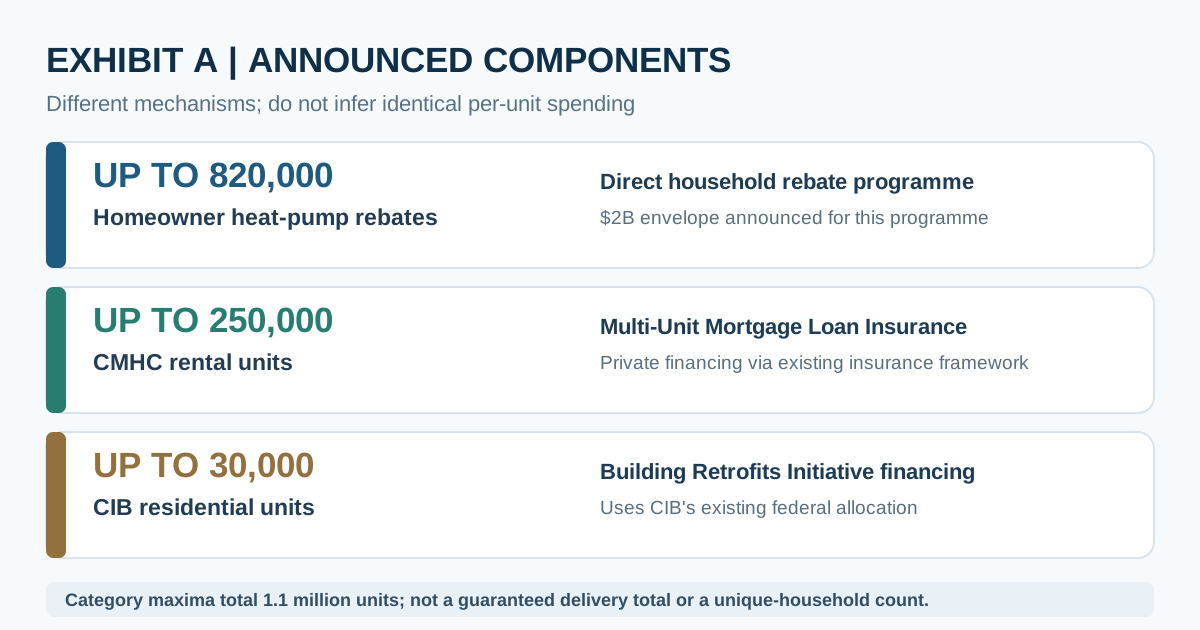
Exhibit A • announced components
Three distinct mechanisms
Sum of stated category maxima: 1.1 million units. Not a confirmed delivery total or unique-household count.
How the average higher-tier award changes the result
For a fixed 820,000-household illustration, paying every household a $2,000 standard amount consumes $1.64 billion. If all $2 billion were available for these rebate payments, the remaining $360 million would finance only the increment above $2,000 for higher-tier recipients. It is not a separate pot equal to their total grant payments.
For example, a household receiving a $6,000 grant uses $4,000 of that incremental capacity; the first $2,000 is already counted in the baseline. At that average, the $360 million difference supports 90,000 larger awards rather than only 45,000.
Assumptions for the table and Exhibit B: exactly 820,000 households participate; all receive either the $2,000 standard award or a higher award averaging the stated amount; the full $2 billion is available for rebate payments; no other costs are deducted; no further funding is assumed. These are illustrations, not proposed programme rules or forecasts of award amounts.
| Assumed average higher-tier award | Extra per higher-tier recipient above $2,000 | Higher-tier households supported | Share of 820,000 households |
|---|---|---|---|
| $4,000 | $2,000 | 180,000 | 21.95% |
| $6,000 | $4,000 | 90,000 | 10.98% |
| $8,000 | $6,000 | 60,000 | 7.32% |
| $10,000 | $8,000 | 45,000 | 5.49% |
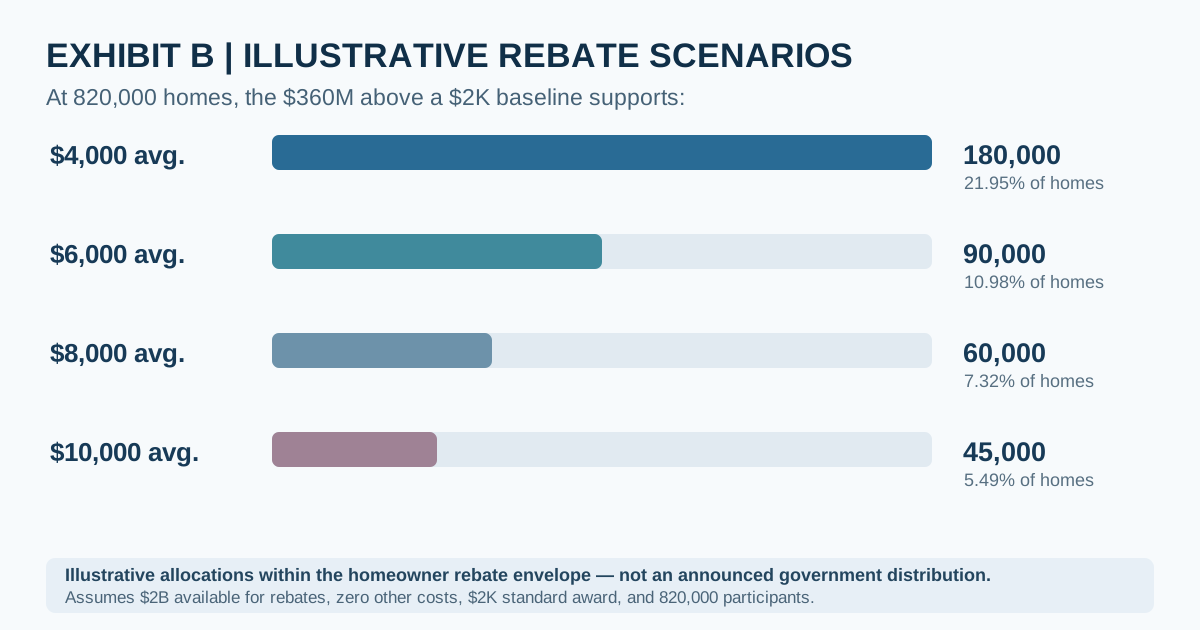
Exhibit B • illustrative allocations
Average award changes capacity
21.95% of 820,000 participants; $2,000 incremental per higher-tier award
10.98% of 820,000 participants; $4,000 incremental per higher-tier award
7.32% of 820,000 participants; $6,000 incremental per higher-tier award
5.49% of 820,000 participants; $8,000 incremental per higher-tier award
Fixed 820,000 homes; all $2B available; no other costs. Not a government forecast.
A general funding-capacity equation
B is the total funding envelope; C is administration or other costs charged to that envelope; N is the total number of participating households; L is the assumed standard award; and H is the assumed average higher-tier award. The equation applies only where H > L, the remaining budget B − C − N × L is non-negative, and the calculated higher-tier count does not exceed N. In practice, award distributions and numbers of participants may also need to be modelled jointly.
The $10,000 endpoint: a specific two-payment scenario
The often-cited 45,000 result is correct only under all of these assumptions, stated before using the figure:
- Exactly 820,000 households receive a rebate.
- Every household receives either exactly $2,000 or the full $10,000.
- The entire $2 billion is available for those payments.
- No administration is deducted from that envelope.
- No additional funding is assumed.
Under this specific two-payment scenario, 45,000 households could receive $10,000 and 775,000 could receive $2,000. This is neither an official allocation nor a forecast of how many lower-income households will receive assistance. A higher-tier average below $10,000 supports more higher-tier recipients, as Exhibit B shows.
A different question: what if participation changes?
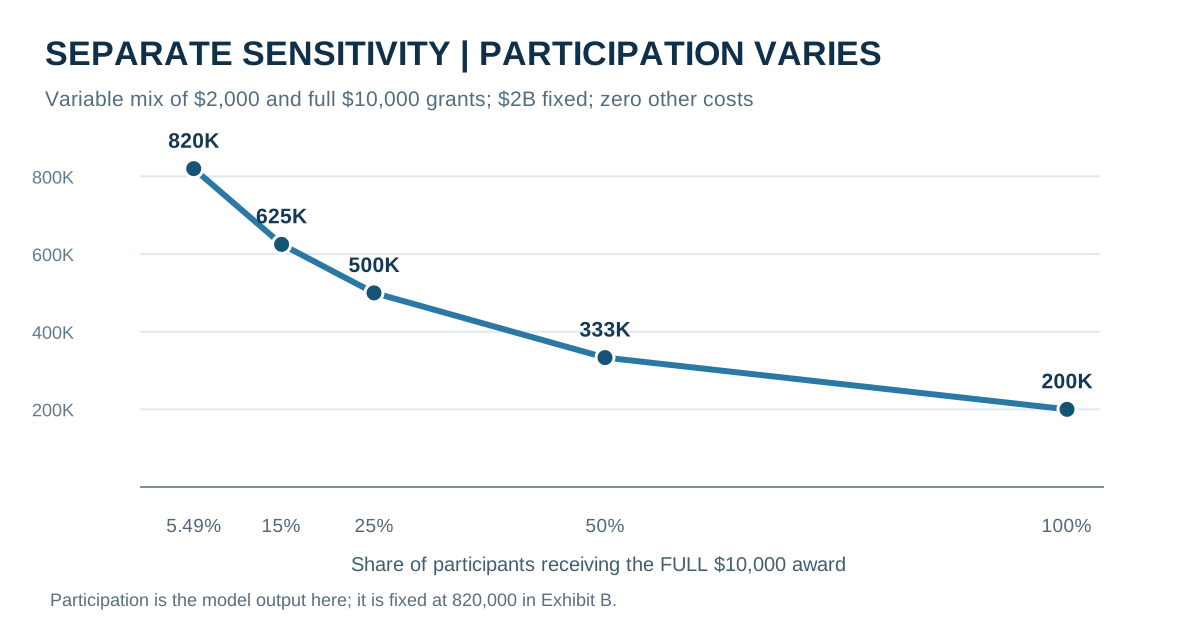
The preceding analysis holds participation at 820,000 and varies the average higher-tier award. A separate sensitivity test fixes the total funding at $2 billion and varies the mix of standard $2,000 and full $10,000 payments; total households funded then changes. That is what the figure below depicts. It does not model an even 50/50 split: it models a variable mix of $2,000 and full $10,000 payments.
Separate sensitivity • participation varies
Mix changes homes funded
Variable mix of $2K and full-$10K payments; not the fixed-participation average-award test above.
For this test, the maximum modelled homes funded equals $2 billion ÷ [$2,000 + ($8,000 × share receiving $10,000)]. At a 15% full-award share, the implied average payment is $3,200, funding 625,000 homes. At a 50% share, the implied average is $6,000, funding about 333,333 homes. Neither percentage is a projected applicant mix.
Three variables the announcement cannot yet resolve
1. Average higher-tier awards
The official term up to $10,000 describes a ceiling, not how many applicants will qualify for that amount or how much smaller qualifying awards might be. Without an expected average and award methodology, a precise recipient split cannot be inferred. October 8 federal backgrounder.
2. Actual participation and applicant mix
The figure 820,000 describes up to that many homeowners. It is not a guaranteed number of applications, approved installations or payments. A median-income eligibility condition also does not imply that half of eventual participants will be in the higher-payment group; homeowners must apply and satisfy applicable conditions. October 8 announcement.
3. Costs charged to the rebate envelope
If administration or other delivery costs are paid from the same $2 billion envelope, less funding would remain for rebates. The materials reviewed do not establish how much would be deducted for those purposes, or conclusively specify the treatment of those costs within that envelope. No arbitrary administrative percentage is assumed here. Federal backgrounder, checked October 16, 2026.
Eligibility and timing: what homeowners can establish today
Review date: October 16, 2026. The published federal backgrounder describes $2,000 for other eligible homeowners, up to $10,000 for households below median income, an Eligible Products List for heat pumps, no pre- or post-retrofit energy audit, and an application flow involving pre-approval. It also mentions one rebate per person. The full income cutoff methodology and final operative application conditions were not provided on the government programme page reviewed today. Eligibility under the prior Oil to Heat Pump Affordability programme should not be substituted for the new programme’s unpublished thresholds. See the federal backgrounder.
Launch status, checked October 16, 2026: the official One million home energy retrofits page invites people to register for launch-date and eligibility updates; it does not present a live rebate application in the material reviewed. The Prime Minister’s October 8 speech expressed an expectation about a January portal, but that is not the same as a live, legally operative application process. Verify the current programme status directly.
Processing: the October 8 backgrounder describes approvals within 24 hours and payment approval within five days after submission of receipts for a pre-approved installation. Those are announced service targets, not guaranteed bank deposit dates or evidence that a pre-launch installation automatically qualifies. The reviewed materials do not settle retrospective treatment: “not confirmed” should not be read as “definitively prohibited.”
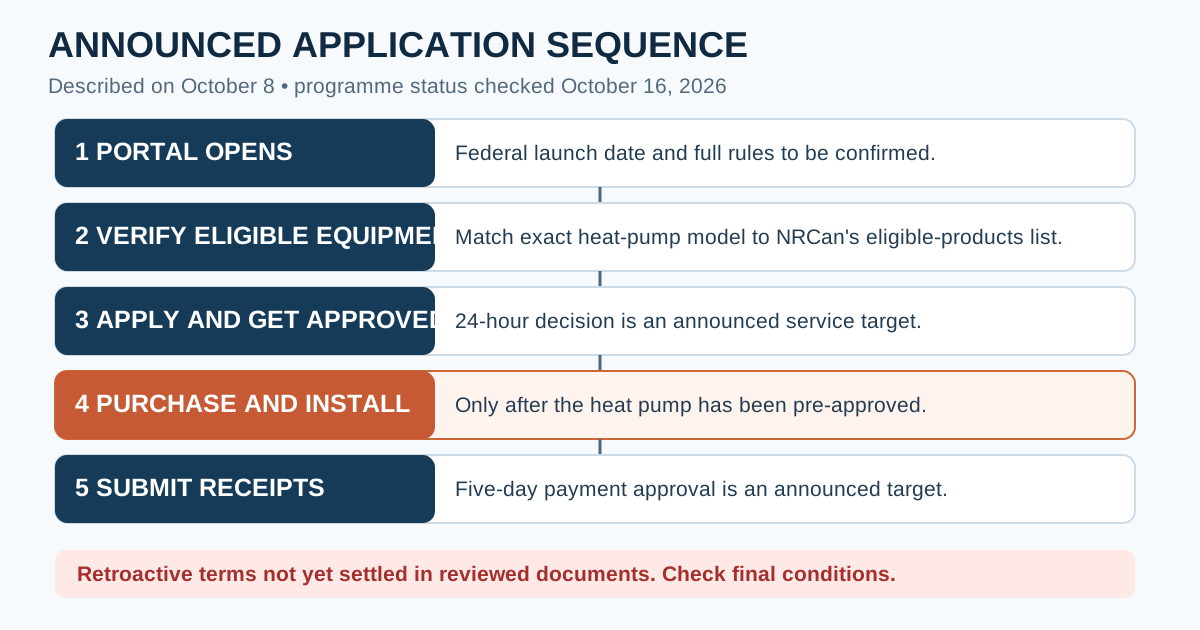
Announced application sequence
Approval before installation
Full legally operative conditions and retrospective treatment remain to be clarified.
For a purchase decision, compare cold-climate air-source heat pumps, check heat pump installation costs, verify proper heat pump sizing, and use the heat pump buying guide for contractor questions. Check currently available provincial heat pump rebates—including our Ontario heat pump rebates guide if applicable—rather than assuming the new federal rebate can be claimed now.
For operating economics, compare heat pump vs oil furnace costs, heat pump vs propane heating, and heat pumps versus gas furnaces. The government’s cited average annual savings above $1,400 concerns oil, propane and electric-resistance heating in its backgrounder—not natural gas—so model your own energy prices using our operating-cost guide. Federal source, October 8.
Frequently asked questions
Does $2,439 represent the average heat pump rebate Canadians will receive?
No. It is the announced $2 billion envelope divided by the up-to-820,000-household target. That ratio is a budget benchmark, not a published forecast of average cheques.
Does the budget mean only 45,000 homeowners can get the $10,000 rebate?
No. A count of 45,000 follows only from a special scenario in which exactly 820,000 households participate, everyone receives either $2,000 or the full $10,000, and the entire $2 billion funds those payments. Smaller average higher-tier awards support more higher-tier recipients.
Is the National Heat Pump Rebate accepting applications?
The official federal programme page reviewed on October 16, 2026 invites visitors to sign up for future launch information, rather than submit an application. Verify its current status directly before making a purchase decision.
Can an installation made before the federal portal opens receive the new rebate?
The October 8 backgrounder describes approval before purchase and installation, but the materials reviewed on October 16 do not establish the full final conditions or the treatment of pre-launch installations. Do not assume either automatic eligibility or a definitive prohibition.
Are the announced 24-hour and five-day periods guaranteed?
No. The federal backgrounder describes approval within 24 hours and payment approval within five days after receipt submission. They are announced processing targets, not evidence that every application or bank deposit will meet those times.
Methodology and primary sources
The equations are independent arithmetic, not a government modelling release. Exhibit A uses announced category maxima; Exhibit B varies the average higher-tier award at fixed 820,000 participation; the separate participation sensitivity instead varies the full-$10K share at a fixed $2 billion envelope. Each figure states its assumptions adjacent to the result. No administrative percentage, annual award allocation or expected applicant share has been inferred.
Originally published October 15, 2026. Substantively updated and official government sources reviewed October 16, 2026. Programme eligibility and timing statements are snapshots, not assurances of future conditions.
- Environment and Climate Change Canada, October 8, 2026 — funding and programme backgrounder.
- Prime Minister of Canada, October 8, 2026 — announcement and headline amounts.
- Government of Canada — National Heat Pump Rebate launch updates, reviewed October 16, 2026.
- Natural Resources Canada — prior OHPA programme (historical distinction only).
What the funding arithmetic establishes
The announced figures establish a funding constraint, not a contradiction. At 820,000 households, a $2,000 baseline leaves $360 million for larger awards before any other costs charged to the envelope. Whether the programme can reach that participation level while supporting lower-income households depends on the average higher-tier payment and the eventual applicant mix. Those assumptions remain the key missing information.
Estimate installed costs before assuming any rebate
Use an independent planning range for equipment and installation; subtract an incentive only after checking the current eligibility and timing rules.
Use the Heat Pump Cost Calculator